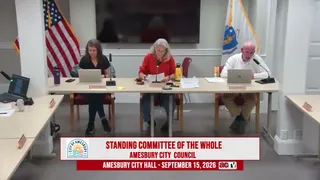
City Council Standing Committee of the Whole Meeting
Councilors continued debate on an ordinance to formalize City Clerk compensation and review procedures, and the Committee recommended approval of: 1) Bill 2026-129 to accept MGL c.140 §139C waiving dog-license fees for residents 70+, 2) Bill 2026-130 to accept a $25,000 FY27 grant to modernize the Costello Center kitchen for Council on Aging services, and 3) Bill 2026-133 to appropriate $30,000 from the Smart Growth Stabilization Fund for pilot traffic-calming measures.
The Committee of the Whole heard substantial debate on Bill 2026-128, an ordinance to formalize City Clerk compensation and an annual review process. Sponsors argued the measure would create a transparent review process and align the clerk’s salary with municipal benchmarks; the City Clerk endorsed a $100,000 base salary and the administration raised legal and appropriation concerns and recommended that review procedures likely belong in Council rules rather than an ordinance. After extended discussion about charter authority, budgeting and KP Law review, the Council voted to continue consideration of the ordinance to the October Committee meeting to gather legal input and refine language.
The committee took positive committee-level positions on several substantive items. They unanimously recommended that the City accept MGL Chapter 140, §139C (Bill 2026-129) allowing the city to waive annual individual dog-license fees for residents age 70 and older. The committee also unanimously recommended the Mayor be authorized to accept and expend a $25,000 FY27 Field Demonstration Project grant for Council on Aging kitchen modernization at the Costello/Costello Center (Bill 2026-130), asking administration to clarify how COA programming would be maintained during construction. Finally, the committee recommended approval of an appropriation of $30,000 from the Smart Growth Stabilization Fund to buy and pilot traffic-calming tools (temporary speed humps, radar/feedback signs, centerline signs and related equipment) in residential neighborhoods (Bill 2026-133); the motion passed 5–2 after debate about deployment policy and prioritization. Public comment included a resident’s critique of recent municipal capital decisions and tax/fee increases; councillors and staff also discussed prior-year invoice processing and other administrative items during the meeting.
Points of interest